By Dairon Canel · Founder, Proven · Updated June 2026
Glossary
What is a Founder's Brief?
A Founder's Brief is a structured validation report Proven generates for a startup idea. It covers ten areas, including everything in the startup validation checklist, each grounded in real signals pulled from Reddit, Hacker News, and App Store reviews, not AI inference about what founders generally care about. Every finding links back to the post it came from.
What's inside
- 01
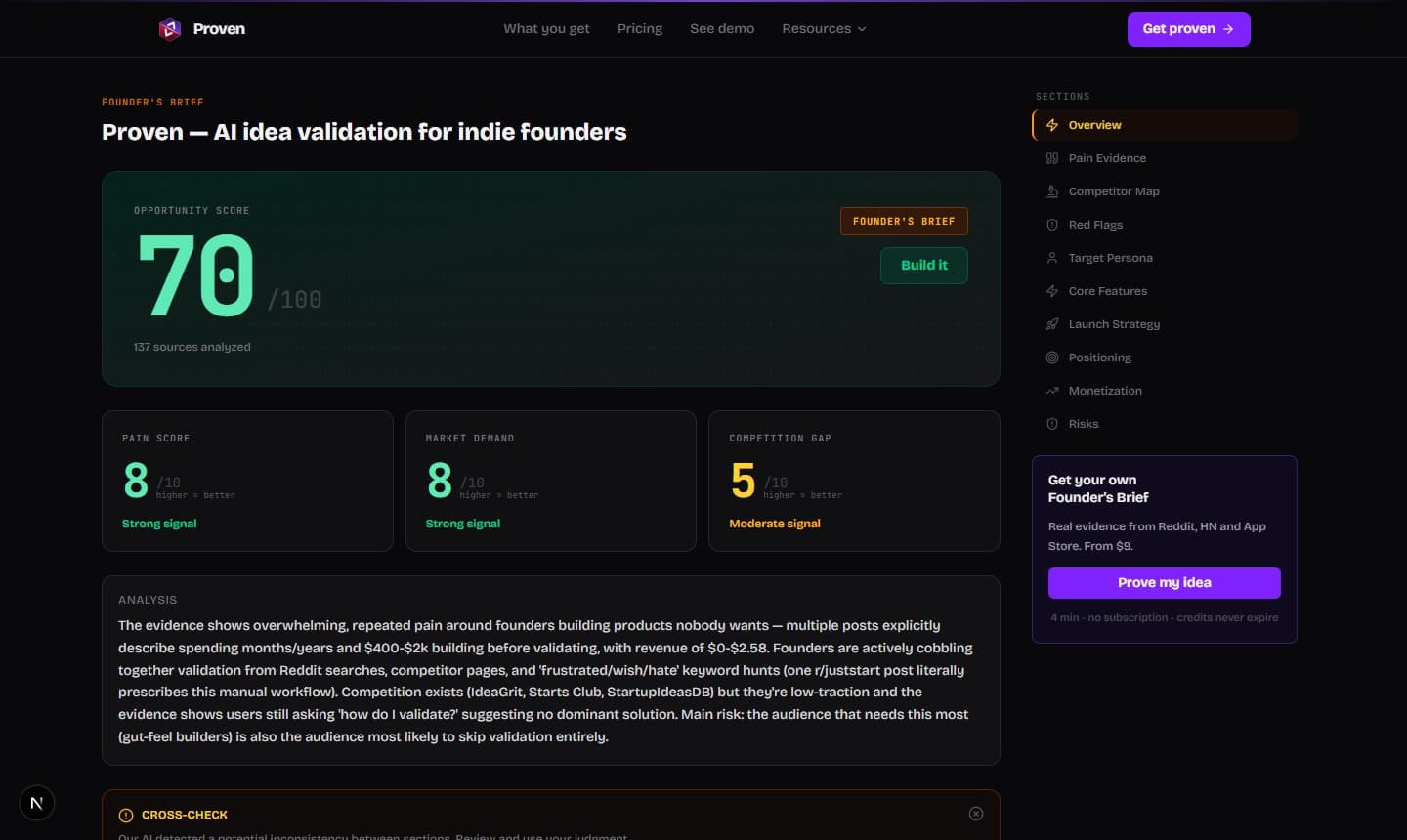
Opportunity Score— A 0–100 signal score based on pain volume and specificity.
The score reflects how much verified pain signal Proven found for your idea, not a theoretical market size estimate. A score above 70 means high-volume, emotionally specific posts across multiple sources. Below 50 means the signal is thin or absent, and the verdict will say so. It's a summary indicator; the Pain Evidence section below it is where you read the actual posts.
- 02
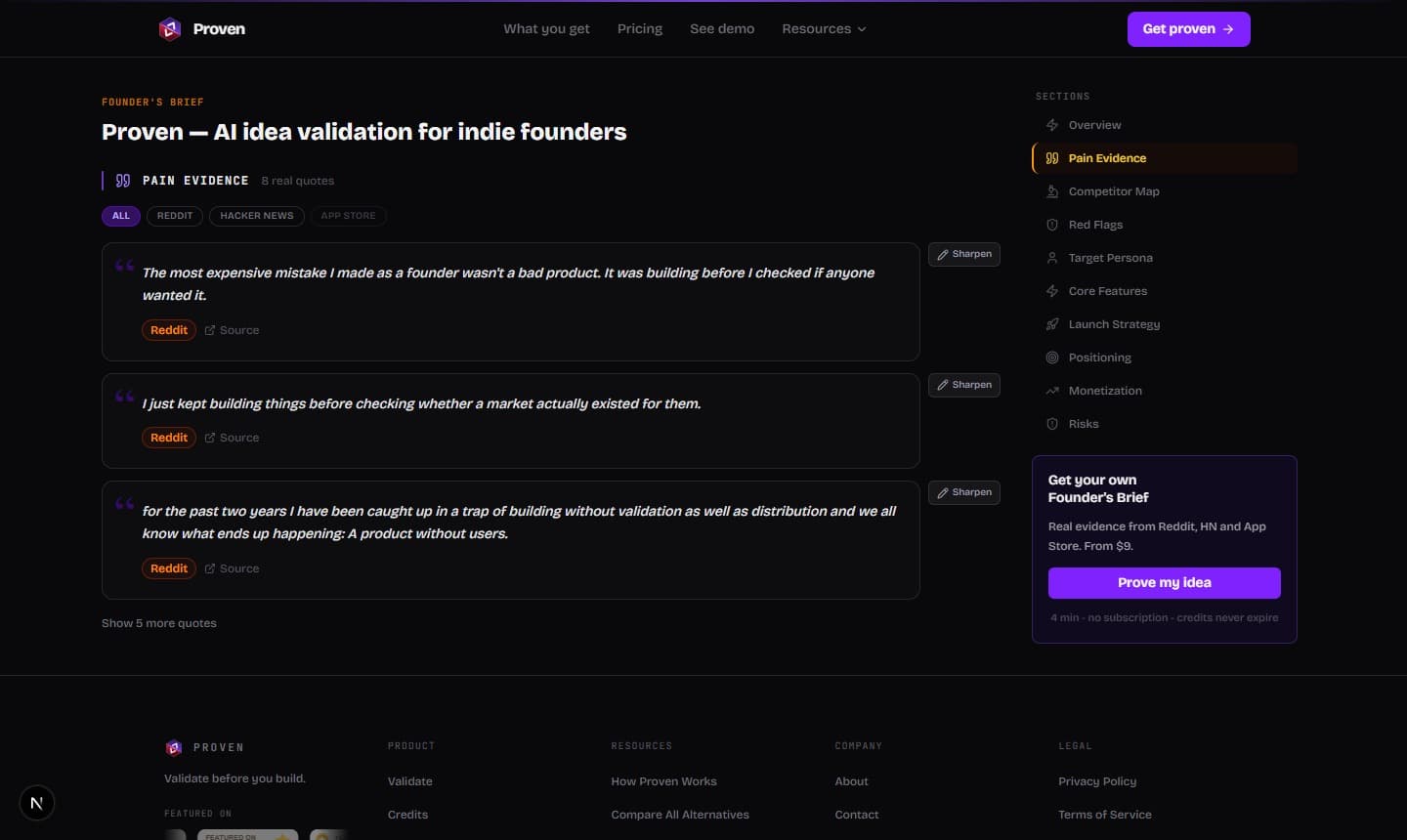
Pain Evidence— 8–15 real quotes from live posts, each linked to the source thread.
Each quote is selected because the language is specific, frustrated, and clearly describing a problem, not a general observation about a category. Every quote links directly to the original thread so you can read the full context, check the date, see the upvotes, and judge the signal yourself. This is the section most founders spend the most time in.
- 03
Competitor Map— Existing solutions found in the wild, with positioning gaps identified.
Proven finds competitors by searching for what people tried when they had the pain you're solving, not by querying a startup database. The result is a map of actual alternatives people reached for, with notes on where they fell short according to the posts that mentioned them. This is where founders most often discover something that changes their plan.
- 04
Red Flags— Signals that challenge the idea: market saturation, failed predecessors, low willingness to pay.
Red Flags surfaces the evidence that works against your idea, not just what supports it. This includes signs of market saturation, posts where founders describe building your concept and failing, and threads where potential customers say the pain isn't bad enough to pay for a solution. If there are no red flags in the evidence, the section will say so, and that itself is a strong signal.
- 05
Target Persona— Who has this pain, how often, and what they say they would pay.
Built from demographic signals in the posts: job titles mentioned, tools people say they already use, the frequency of the pain, and willingness-to-pay language that appears in the threads. This isn't a marketing persona built from assumptions; it's a pattern that emerges from what real people wrote. It's specific to your niche, not a generic ICP template.
- 06
MVP Features— The features mentioned most in pain threads, prioritized by frequency.
When people describe a pain in detail, they often describe what they wish existed. Proven scores the features mentioned across all evidence posts and surfaces them ranked by how often they appear. The result is a feature list ordered by actual demand, not by what the founder found most interesting to build.
- 07
Go-to-Market Plan— Communities, content angles, and launch platforms your buyers already use.
Built from the same posts that provided the pain evidence: the subreddits, forums, and platforms where the conversations are happening are the same places your first customers already spend time. Proven maps these into a starting GTM strategy that begins where the pain is already being expressed. Most founders are surprised by at least one community that appears here.
- 08
Positioning— Where your idea fits relative to existing alternatives.
The positioning section uses the competitor map and pain evidence together to identify the specific gap your idea occupies: where competitors fall short and what claims would be credible given the evidence. This is a starting point for messaging, not a finished brand strategy. It tells you what you can honestly say, not just what sounds best.
- 09
Monetization— Pricing signals from the posts: what people said they paid, what felt too expensive.
Real pricing signals are rare, but when they appear in posts ("I'd pay $20/month for this," "the existing tool charges $200 and it's not worth it"), Proven surfaces them. The monetization section aggregates these signals into a pricing range grounded in what the market has actually said, not what founders typically assume they can charge.
- 10
Risk Map— The patterns most likely to kill this idea, with early warning signals to watch.
The risk map cross-references red flags, competitor failures, and market signals to identify the specific ways this idea is most likely to fail, not generic startup risks. If the evidence shows repeated churn from switching costs, or a persona that chronically undervalues solutions, these become named risks with early warning indicators to watch. This section is worth re-reading after six months of building.
How a Founder's Brief is different from a validation score
A validation score tells you a number. A Founder's Brief tells you why. The difference matters because a number without sources cannot be challenged, updated, or acted on. When a brief tells you the Pain Score is 74, it's because 74 reflects the volume and intensity of specific posts you can open and read.
Each of the ten sections is specific to the idea you submitted. The competitor map shows companies people actually mentioned trying. The persona reflects the language real people used. The risk map surfaces the patterns that appear in your evidence, not a generic list of startup failure modes. There's no template being filled in. The brief is built from what Proven found for your specific market, on the day you submitted.
Who a Founder's Brief is for
A Founder's Brief is most useful at the pre-code stage, before you've built anything and while the cost of changing direction is still low. Solo founders validating a new idea, founders pivoting an existing product to a new market, and early-stage investors doing quick market diligence on a pitch all use it for the same reason: they need to know whether the pain is real before committing to the build.
It's less useful after you've already launched and have real customer data. At that point, your own users are a better signal than market posts. But before launch, a Founder's Brief is the fastest way to find out if you're solving a problem the market is actively expressing, or one you invented in your head.
How long it takes and what it costs
A Founder's Brief takes about 4 minutes to generate from the moment you submit. Proven fetches and scores live posts in real time. There's no queue and no waiting for a human analyst. One brief costs $9 and includes 3 improvements plus free idea sharpening. Packs of 5 ($29) and 15 ($59) briefs bring the per-brief price down for founders validating multiple ideas. There's no subscription required and briefs never expire.
“The report is quite comprehensive and SUPER valuable. It goes DEEP and this isn't something you can put together with a single Grok prompt. I am impressed and even got some ideas for the app's distribution phase.”
Emilio Johann
Founder, Veramind
Frequently asked questions
How long does a Founder's Brief take to generate?
About 4 minutes from submission to a completed brief in your dashboard. Proven fetches live posts from Reddit, Hacker News, and App Store reviews in real time, scores 150+ signals, maps competitors, builds a persona, and structures all of it into 10 sections, with no waiting queue. The brief is ready by the time you've made a coffee.
How much does a Founder's Brief cost?
One brief costs $9 and includes 3 improvements plus free idea sharpening. Packs of 5 ($29) and 15 ($59) briefs bring the per-brief price down for founders validating multiple ideas. There's no subscription: you pay per brief, per idea, and briefs never expire.
What if Proven can't find evidence for my idea?
Your brief will be honest about it. A low Pain Score, low signal volume, and a verdict of 'Explore more before building' or 'Kill it' is a real output, not an error. The absence of evidence is information: it means your market isn't visibly expressing this pain in the sources Proven searches. That's worth knowing before you build.
Can I generate multiple briefs for the same idea with different framings?
Yes, and this is one of the most valuable uses of Proven. If your first brief returns a weak Pain Score, try reframing the pain you described: different persona, different trigger, different level of specificity. Multiple briefs for adjacent framings of the same idea often surface the angle with the strongest market signal, which is the one worth building toward.
Is the Founder's Brief the only output from Proven?
Yes. Each brief is the complete output for a single idea submission. There are no add-ons, no separate reports, and no follow-up surveys. Everything Proven found (pain evidence, competitors, persona, features, GTM, risks, and the verdict) is in the one brief, structured and ready to act on.
Learn how Proven generates a brief or read about the Pain Score in detail.
Written by Dairon Canel with AI assistance for research and structure.