By Dairon Canel · Founder, Proven · Updated June 2026
Comparison
Proven vs ChatGPT
The question isn't whether ChatGPT is smart. It is. The question is whether it can tell you if people will pay for your specific idea, right now, in the market you're about to enter — the central question of startup idea validation. It cannot. Here's why the difference matters before you spend four months building something nobody asked for.
What ChatGPT actually knows about your market
ChatGPT was trained on a snapshot of the internet collected at a fixed point in time. That snapshot includes millions of articles, forum posts, and discussions about startups, markets, and founder pain — but it was frozen when training ended. When you ask ChatGPT whether your idea has a market, it answers from that frozen record.
It has no access to what people on Reddit said about your exact pain last Tuesday. It cannot fetch a live Hacker News thread. It cannot read the App Store reviews your future competitors are collecting right now. It is, in the most literal sense, answering from the past.
This matters more than most founders realize. Market conversations move fast. A pain that generated 50 posts in 2023 might have three viable tools addressing it by 2026. A problem nobody talked about publicly 18 months ago might have exploded into a frustrated community of 200,000 people since then. ChatGPT sees neither. It gives you the best answer it can from old data — and it gives that same answer to everyone who asks a similar question about a similar market.
How Proven searches for evidence differently
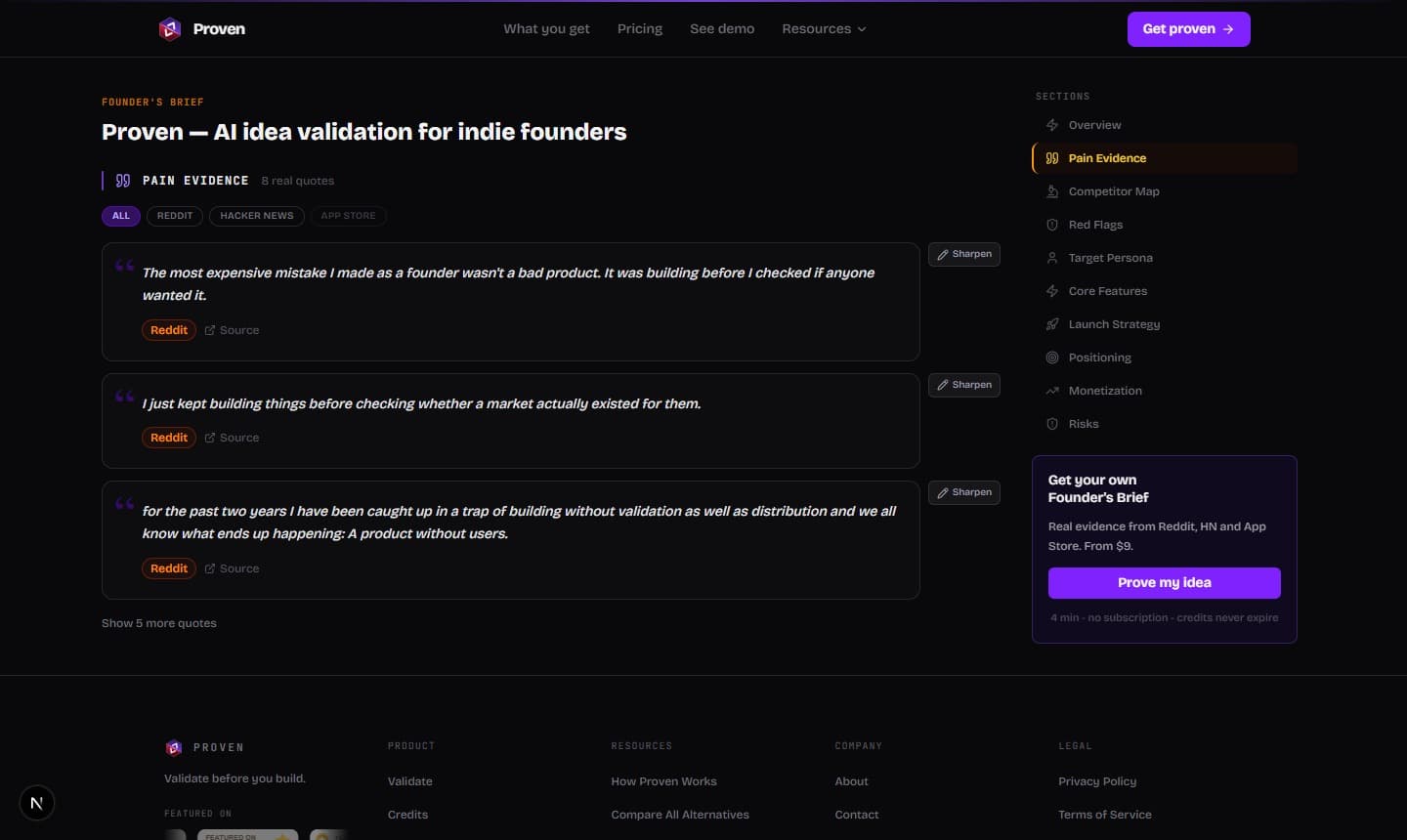
Proven doesn't answer from training data. When you submit your idea, Proven fetches live posts from Reddit, Hacker News, and App Store reviews at that exact moment — not a cached version from six months ago. The pipeline scores each post for pain intensity, specificity, and market signal. The strongest evidence surfaces in your roadmap.
Every pain quote Proven returns links directly to the source thread. You can click it, read the original post, check the date, see the upvotes, read the replies. When Proven tells you there are 42 Reddit posts about your exact market pain, it means 42 posts exist right now — by real people, with their usernames, timestamps, and full context. That is verifiable. That is evidence.
When ChatGPT tells you the market exists, it means the market existed somewhere in its training data — without sources, without dates, and without any way to check. That is an opinion. Confident-sounding, plausibly accurate, but an opinion. The difference between an opinion and evidence is the difference between building on hope and building on signal.
The objectivity problem
ChatGPT is designed to be helpful. In practice, for idea validation, that means it tends to validate what you want to hear. If you describe your SaaS idea enthusiastically and ask whether it has market potential, the response will almost always find reasons to say yes. The model is optimized for user satisfaction, not for giving you the signal your idea actually needs.
Proven is built with the opposite objective. The pipeline surfaces what challenges your assumptions as often as what supports them. If your idea has a weak Pain Score, few posts, vague language, low emotional charge in what little exists, Proven says so directly and tells you why. If the competitor map turns up three established tools with five-star reviews solving the exact problem you described, that shows up too.
A verdict of “Explore more before building” is a success case for Proven. It saved you four months. A verdict of “Build it” backed by live pain posts you can open, clear competitor gaps, and a defined persona is a green light you can actually trust, not one a language model generated to make you feel good about your morning.
“It's not just a wrapper that connects to an LLM, I bet the internal prompting is robust. Reddit quotes that I can get into and try to low key insert my app into. Competitor map showed clear competitors and actually got me stoked because they're not attacking the pain point I'm solving — that proves my app could work.”
Eduard Nicolae Petrache
Founder, ReceiptsMRR
ChatGPT vs Proven — side by side
ChatGPT / Claude Generic AI validation | Proven | |
|---|---|---|
| Evidence source | Training data — no live search | Live posts from Reddit, HN & App Store |
| Objectivity | Validates what you want to hear | Surfaces what challenges your assumptions |
| Verifiable sources | No sources cited | Every quote links to the post it came from |
| Idea-specific | Same answer regardless of your market | Searches live for your exact niche, right now |
| Competitors | Hallucinated, not verified | Real competitors found, positioned, gaps mapped |
| What you get | Information — no next steps | GTM plan, feature list, risk map, verdict |
When does ChatGPT make sense for founders?
ChatGPT has real uses in the early ideation phase. It can help you articulate an idea more clearly, brainstorm adjacent pain areas, pressure-test a business model structure, or draft the language you'll use when talking to potential customers. These are things it's genuinely good at — they require language fluency and broad pattern recognition, not live data.
What it cannot do is tell you whether real people have this pain right now, what they've already tried, what they'd pay, or who else is already solving it with a product they love. Those answers require live investigation. Use ChatGPT to think. Use Proven to validate. They are different tools for different jobs — and confusing the two is how founders spend six months building something the market already has, or something nobody actually wanted.
The best workflow: use an AI assistant to sharpen your problem statement before you submit to Proven. The more precisely you describe the pain you're trying to solve, the more targeted Proven's evidence search will be. Then let live data give you the honest answer.
Frequently asked questions
Can ChatGPT validate a startup idea?
Not reliably. ChatGPT answers from training data — patterns collected months or years before you ask. It has no access to what people are saying about your specific market right now. It cannot cite real Reddit posts, HN threads, or App Store reviews. For idea validation, you need live evidence from actual people experiencing the pain — not a statistical summary of what the internet said in the past.
What's the difference between ChatGPT and Proven for market research?
The core difference is sources. ChatGPT interprets your idea through the lens of its training data and generates plausible-sounding analysis with no citations. Proven fetches live posts from Reddit, Hacker News, and App Store reviews at the moment you submit, scores each post for pain signal strength, and links every quote back to the original thread. One gives you an opinion, the other gives you verifiable evidence.
Does Proven use ChatGPT?
Proven uses Claude by Anthropic for its analysis layer — not ChatGPT. But the AI model is almost beside the point. The real advantage is the live evidence pipeline underneath it. Any AI model working from live market data will outperform any AI model working from training data alone, for validation purposes. Proven's value is that pipeline, not which AI processes the results.
Can I use both ChatGPT and Proven together?
Yes — and it's a good workflow. Use ChatGPT or Claude to help you articulate your idea clearly before submitting to Proven: sharpen the pain statement, identify your target persona, think through what you're actually solving. The more precisely you describe the problem, the more targeted Proven's evidence search will be. Then let live data give you the honest answer.
Why doesn't ChatGPT cite sources when it validates ideas?
Because it doesn't have sources to cite. ChatGPT's knowledge is baked into its model weights during training — it has no mechanism to retrieve a specific Reddit post or App Store review that exists today. When it says 'many founders struggle with X,' it's pattern-matching from training, not referencing specific people. Proven is built to retrieve, score, and cite specific live posts — so you can judge the evidence yourself.
Written by Dairon Canel with AI assistance for research and structure.